Mediation and arbitration are both ways of resolving disputes outside court. Because of that, people often confuse them. But they work very differently, and the difference matters when you are choosing how to handle a conflict.
The simplest way to remember it: in mediation, the parties decide. In arbitration, someone else decides.
Key takeaways
- Mediation is guided negotiation. A neutral mediator helps the parties reach their own agreement.
- Arbitration is a private hearing. A neutral arbitrator listens to both sides and makes the decision.
- Mediation gives the parties control and can help protect relationships.
- Arbitration gives a decision when the parties cannot agree.
- The 40 Hours Professional Mediation Course at Elearn Training Institute is a place to start if you want to mediate.
Ready to Get Started?
Take the next step in your professional development.
What is mediation?
Mediation is guided negotiation. A neutral person, the mediator, helps two or more parties talk, understand each other's concerns, explore options and work towards an agreement.
The mediator does not decide the outcome. The parties do. The mediator guides the conversation, asks questions and keeps the discussion constructive, but does not impose a solution.
If the parties agree, they record what they agreed. If they do not, they remain free to choose another route.
What is arbitration?
Arbitration is a private hearing. A neutral person, the arbitrator, listens to both sides, looks at the evidence and makes a decision.
The parties do not negotiate the outcome. They present their case, and the arbitrator decides. Parties usually agree in advance to accept that decision.
Apply now: Start with the 40 Hours Professional Mediation Course at Elearn Training Institute. Questions? WhatsApp +254 701 893 388.
The key differences
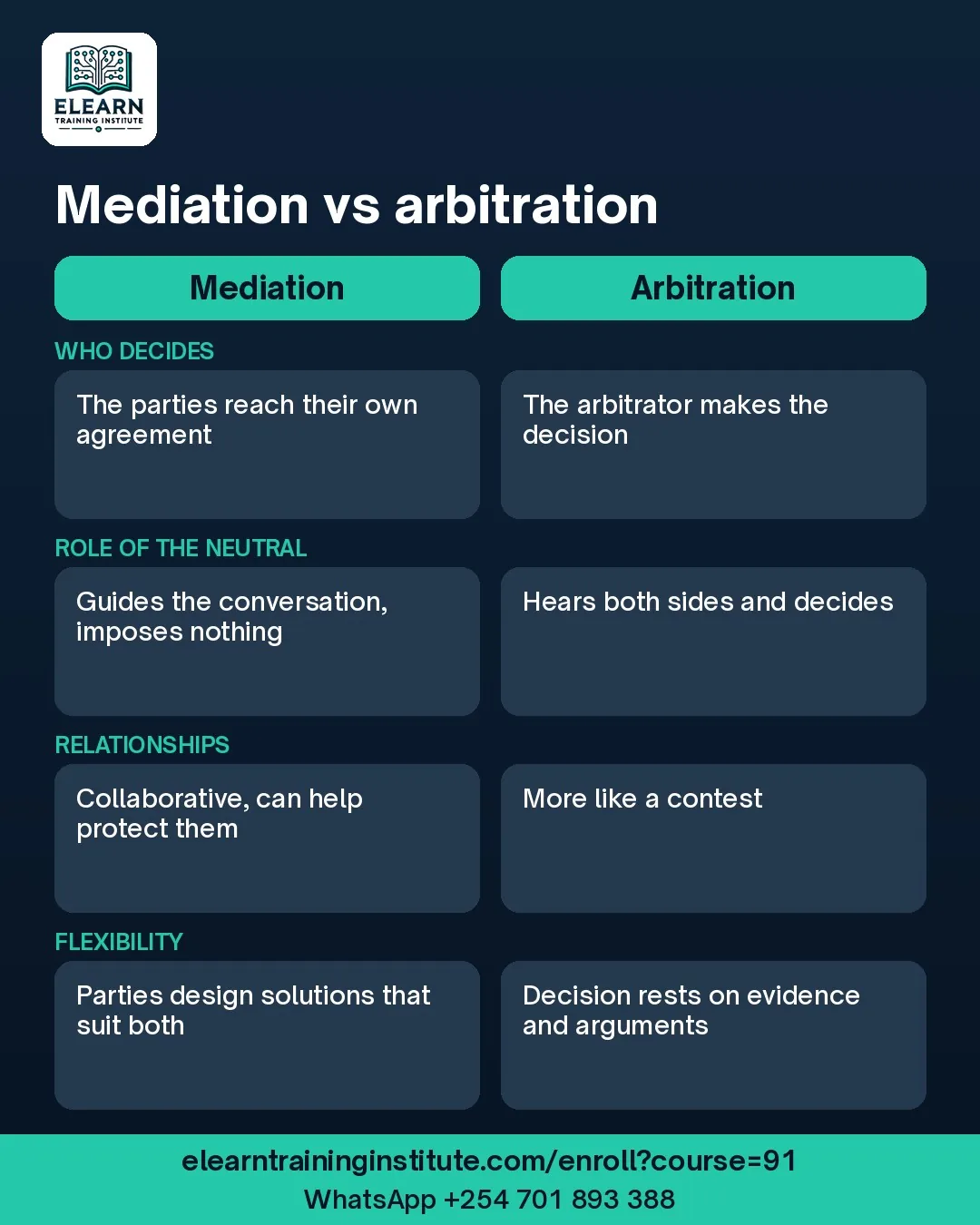
Who decides. In mediation, the parties shape and accept their own agreement. In arbitration, the arbitrator decides.
Relationships. Mediation is collaborative, so it can help people keep working relationships, family ties or business partnerships. Arbitration is more like a contest, with one side's case preferred over the other's.
Flexibility. In mediation, parties can design solutions that work for both sides. In arbitration, the decision rests on the evidence and arguments presented.
Walking away. In mediation, either party can walk away before agreeing. In arbitration, the parties have usually committed to the process from the start.
When mediation fits
Mediation fits when both sides want to keep the relationship, are willing to talk, and are open to creative solutions. It is common in workplace disputes, family conflicts, business partnerships and disagreements between neighbours.
It is harder when one party will not take part in good faith, or when there is a serious imbalance of power between the parties.
When arbitration fits
Arbitration fits when the parties need someone else to decide, want a private process, and have agreed to accept the outcome. It is often written into commercial and business contracts.
Does the mediator become the arbitrator?
No. They are separate roles. If mediation does not lead to agreement, the parties may choose arbitration, but with a different neutral person. A mediator hears things in confidence, so acting as the judge afterwards would undermine trust in the process.
Where to start with mediation
Managers, HR professionals, teachers and community leaders already handle disputes. Understanding mediation helps them respond with more confidence.
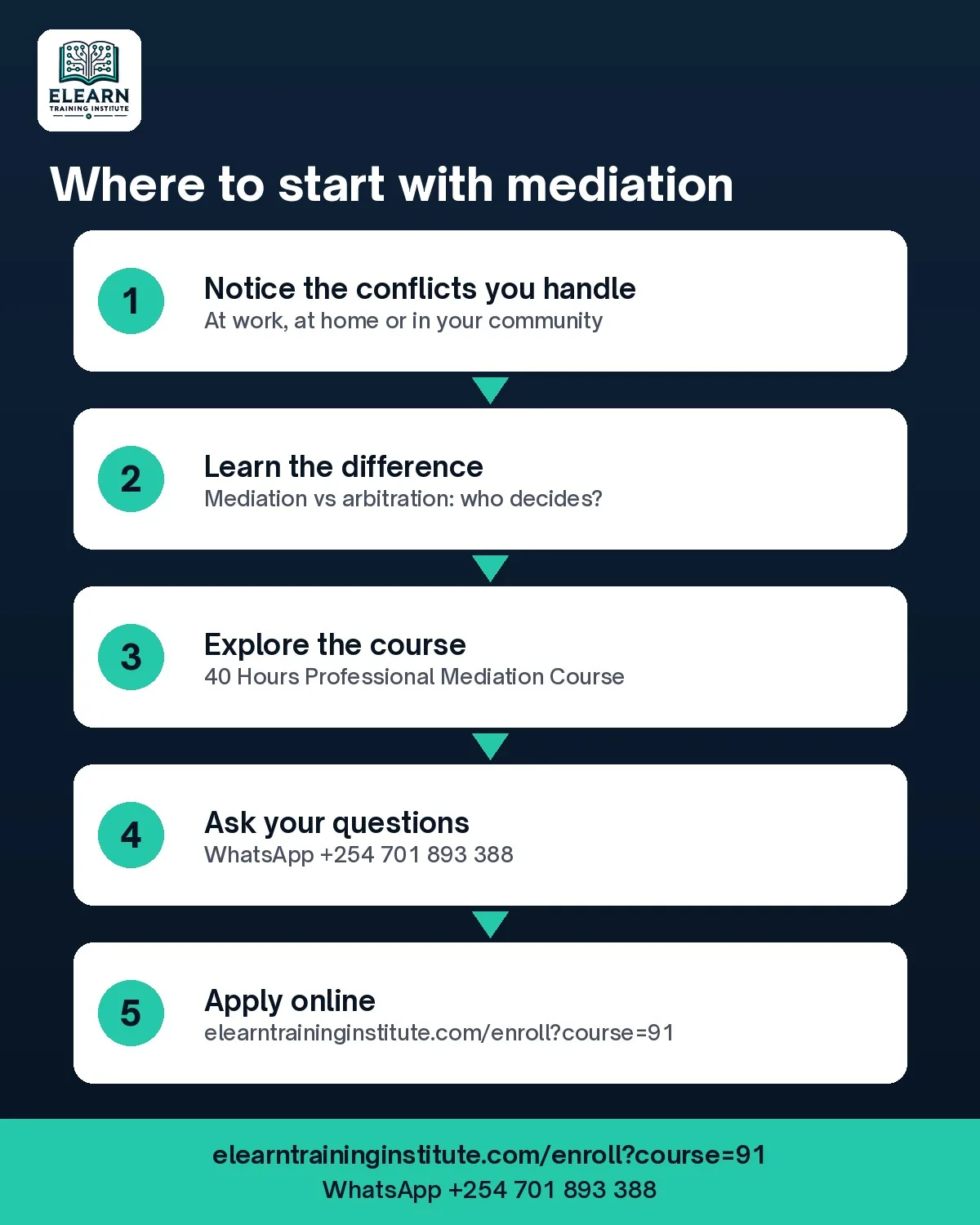
- Notice the conflicts you already handle at work, at home or in your community.
- Learn the difference between mediation and arbitration.
- Explore the course: the 40 Hours Professional Mediation Course at Elearn Training Institute.
- Ask your questions on WhatsApp +254 701 893 388.
- Apply online when you are ready.
Apply now: Enrol in the 40 Hours Professional Mediation Course at Elearn Training Institute, or WhatsApp +254 701 893 388.